
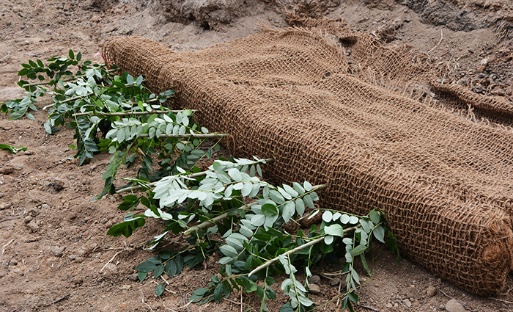
Constructing and protecting a stable slope is one of the most technically demanding tasks in land restoration and civil engineering. Whether the project involves highway embankments, graded construction sites, mine reclamation areas, or ecological restoration zones, the challenge is the same: how do you build a slope that holds its shape, resists erosion, and supports vegetation without relying on synthetic materials that leave a lasting environmental footprint? For engineers, contractors, and restoration professionals seeking nature-based erosion control and coir fiber soil stabilization solutions that go beyond surface protection, the answer lies in a system designed for the face of the slope itself. RoLanka International’s BioD-Block coir block system is a purpose-built bioengineering erosion control product that combines structural integrity with built-in vegetation support. It delivers the performance of slope stabilization materials engineered for demanding conditions while remaining 100% biodegradable, plastic-free, and ecologically sound from installation through to the end of its functional life.
Understanding how BioD-Block works requires looking at both its physical construction and the soil lift method it is designed to support.
What Is a Vegetated Soil Lift and Why Does It Matter?
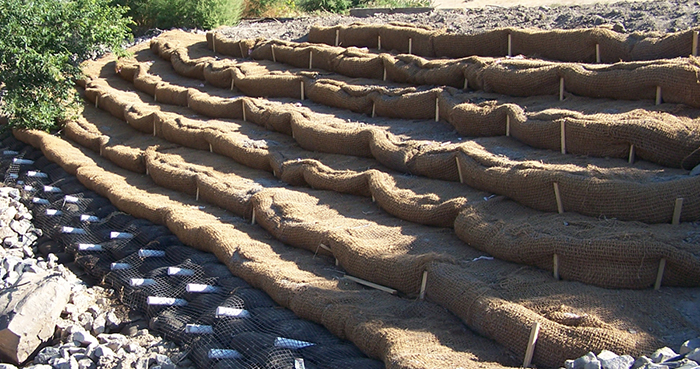
A vegetated soil lift is a construction technique used to build stable, vegetated slope faces in a series of horizontal layers. Each lift consists of compacted fill soil wrapped or retained at its face by a structural element, in this case the BioD-Block, which holds the soil in place while simultaneously creating the conditions needed for native vegetation to establish. The result is a slope face that progressively becomes more biologically stable as plant root systems develop through and around each lift layer.
This approach is widely used in slope bioengineering because it integrates structural support with ecological recovery from the earliest stages of construction. Unlike hard armoring methods such as riprap, gabion walls, or concrete retaining structures, the vegetated soil lift system works with the natural processes of plant growth and organic matter decomposition rather than replacing them. The BioD-Block makes this system easier to construct, more consistent in outcome, and more durable than alternative methods that rely on loosely packed fiber or synthetic geotextile wraps.
The BioD-Block System: Construction and Components
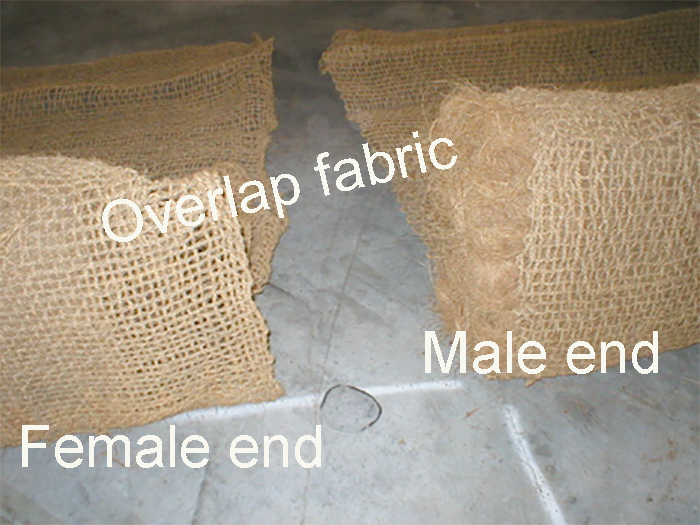
The BioD-Block is a densely packed mattress coir fiber block, 9.8 feet long, attached to a bristle coir woven fabric on three of its four sides. The fourth side is intentionally left open to receive fill soil during construction. This attached fabric is the BioD-Mat 70, one of the high-performance woven coir blankets in RoLanka’s BioD-Mat series, chosen for its strength, durability, and longevity in the field.
The system is available in two heights: 12 inches and 16 inches. The 12-inch block is 5 inches thick, and the 16-inch block is 7 inches thick. These dimensions provide consistent, repeatable lift heights across the full length of a slope face, eliminating the variability that often undermines the structural integrity of manually constructed fiber wraps.
Each BioD-Block unit features a male and female end connection system that links adjacent blocks into a continuous, structurally sound face. This interlocking design prevents gaps or separation at connection points, one of the most common failure modes in modular slope protection systems. The result is a unified slope face that behaves as a single structural system rather than a series of individual components.
Planting Holes: Vegetation from Day One
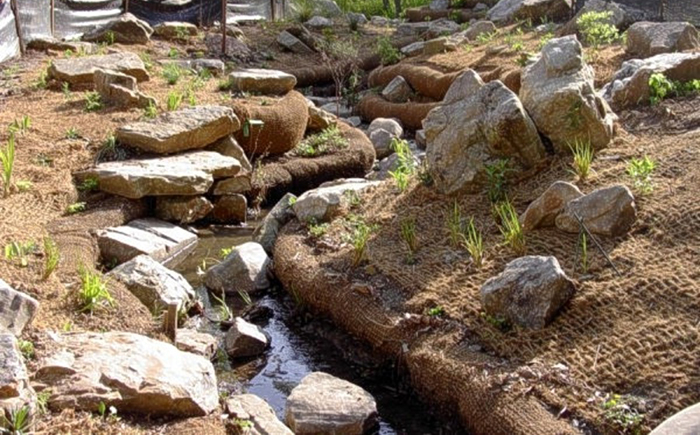
One of the most significant innovations in the BioD-Block system is its integrated planting hole design. Each 9.8-foot block contains nine invisible pre-formed planting holes spaced nine to twelve inches apart along the length of the block. These holes are sealed with removable coir fiber plugs, keeping the block’s structural integrity intact during transport and installation while making planting straightforward and efficient on site.
When the project team is ready to plant, the coir plugs are pulled out to expose the holes, and live plant cuttings, plugs, or root stock can be inserted directly through the face of the block and into the soil behind it. This means that vegetation establishment begins at the moment of construction rather than being deferred to a post-installation phase. Native plants grow through the coir fiber face from day one, their root systems extending into the fill soil and knitting the entire lift structure together over time.
This planting functionality is what distinguishes the BioD-Block from simpler wrapped-fiber systems. The densely packed coir block at the face of the lift provides an excellent growing medium, retaining moisture and moderating temperature in a way that supports seedling survival through the critical early establishment period.
Structural Performance and Longevity
The thick coir fiber block at the face of each unit provides significantly higher structural protection to the soil lift than thinner or lower-density alternatives. The dense fiber mass resists the shear forces and surface erosion that typically act on exposed slope faces during rainfall events, while the attached BioD-Mat 70 fabric provides additional reinforcement across the soil interface behind the block.
In terms of longevity, the coir block component is rated for six to seven years of functional protection in the field, while the attached BioD-Mat 70 fabric maintains its structural contribution for four to six years. This staggered degradation timeline is deliberate and ecologically beneficial. The fabric breaks down first, enriching the soil at the slope interface, while the thicker block continues to protect the slope face until vegetation root systems are sufficiently developed to take over the stabilization role independently. By the time both components have fully biodegraded, no synthetic residue, plastic fiber, or chemical treatment remains on site.
Where BioD-Block Delivers the Greatest Value
The BioD-Block system is most effective on projects where the slope face itself is the primary challenge: steep embankments, graded cut slopes, restored mine sites, highway construction zones, and ecological restoration areas where both structural performance and long-term vegetation establishment are non-negotiable priorities. Its modular design makes it adaptable to irregular slope geometries, and the consistent block height ensures uniform, professional-quality lift construction across large project areas.
For projects governed by environmental regulations or agency specifications requiring plastic-free erosion control and green infrastructure erosion solutions, the BioD-Block delivers full compliance without sacrificing construction efficiency. Its 100% biodegradable composition, combined with its proven structural performance over multi-year timescales, makes it a compelling choice for specifying engineers seeking sustainable alternatives to plastic geotextiles on sediment control for infrastructure projects.
RoLanka International: The Trusted Partner Behind BioD-Block
RoLanka International, Inc., the GA DOT DBE-certified company behind the BioD product family, has spent more than 30 years refining its approach to natural erosion control. Every BioD-Block unit is subject to strict quality control before it leaves the facility, and the product is backed by a limited warranty and free technical assistance for project teams at every stage, from specification through installation. For slope construction projects where the goal is a stable, vegetated, ecologically sound outcome, the BioD-Block system is the natural choice.
Choose RoLanka International for Biodegradable Slope Stabilization That Builds Stronger Ground Naturally
Ready to build slopes that hold, grow, and last? RoLanka International delivers proven coir fiber soil stabilization and bioengineering erosion control products trusted by engineers and restoration professionals across the USA. Contact RoLanka International today and put BioD-Block to work on your next soil lift project.